Sunday, July 30, 2006
Update on Rapid HIV test - Capillus lives
The rapid HIV test discussed in the previous post was developed at Cambridge Biotech which no longer exists. The technology for this test was sold to Trinity Biotech ( www.trinitybiotech.com) which is currently selling several million tests a year primarily into Africa. It is great to see a product one helped develop continue to aid people around the world.


Wednesday, July 26, 2006
Rapid HIV test used in Africa

A number of years ago I worked in development at Cambridge Biotech, which developed and manufactured a number of state of the art HIV test systems. One of our last products to be introduced was a 5-minute test for HIV that used a disposable slide and electronic battery operated reader. If the sample was positive a latex solution formed clumps as the sample flowed through capillary channels in a plastic slide. The results could be read visually or preferably, by the instrument which eliminated interpretation errors. A science magazine, New Scientist, had an article on the issues of routine HIV testing (July 22 2006 pages 8-9). The article included a picture labeled “testing in Africa needs to be backed by treatment” which is of an African reading one of the slides from our product. It is great that the product is still out there helping people.
Friday, July 21, 2006
The Neanderthal genome is to be sequenced

The extinct Neanderthal are our closest relatives. Some believe that we may be a human – Neanderthal hybrid but mitochondrial DNA from ancient bones found only a very distant relationship. The results suggested and humans and Neanderthals had a common ancestor 500,000 years ago, long before modern humans evolved. The sequencing technique to be used in this new study is very different from that used in the human genome project. That technique sequenced relatively long pieces of DNA but the ancient DNA extracted from fossil bones is too short for such techniques. Scientists from Germany's Max Planck Institute for Evolutionary Anthropology are teaming up with a company in Connecticut to map the genome. The company, 454 Life Sciences Corp. has developed an microwell technique using very small beads that can sequence a number of DNA segments in parallel with little equipment and is much better in sequencing short pieces of DNA than more classical techniques. Only 5% of the DNA is Neanderthal in these samples the remainder being bacterial contamination but as bacterial DNA sequences are so different they can easily be identified and removed from the database. It is hoped that this information will aid us in understanding what makes us human.
Thursday, July 20, 2006
More problems with nicotine
Srikumar Chellappan of the University of South Florida, in Tampa, led a study that demonstrated the stimulation of cancer cells by nicotine. Although this is bad news for smokers, understanding the mechanism may aid the development of new anticancer agents. Laboratory results have shown that blocking the nicotine receptors on cancer cells can halt their growth. Experiments revealed that nicotine caused a molecule called Raf-1 to bind to a key protein called Rb, which normally suppresses tumors. It is hoped that chemicals can be found that will inhibit the binding of Raf-1 to the Rb cancer inhibitor.
Journal reference: Journal of Clinical Investigation (DOI: 10.1172/JCI28164)
Journal reference: Journal of Clinical Investigation (DOI: 10.1172/JCI28164)
Wednesday, July 19, 2006
Sailing on Casco Bay Maine
This was a two day adventure. My Swedish friend and I meet in S. Freeport Monday for a sail around Harpswell Neck back up to
Hans and I sleep on the boat. In the morning we had Rye Crisp and peanut butter with coffee for breakfast. Perhaps this is a Swedish thing. The weather report sounded bad with hail and heavy rain predicted for the afternoon so the four of us got an early start on the way back to
Sunday, July 16, 2006
Cycling in Groton MA

It was to be a very hot day so cycling to the Main Street Café in the morning seemed like a good way to get in a ride before the temperature rose. The rail trail was close by and provided a level path to downtown Groton. The coffee group was smaller as it was Sunday. After a couple of ice coffees I headed out to Johnson’s for more talk and some cold water. On the way back I visited S and A to talk about furnishing second homes and then stopped by Tiny’s. They just had a new stone wall built next to the barn and are turning it into yet another flower garden. The was home was easy hitting the level rail trail again. After mucking the stall I went shopping as Wednesday is my wife’s birthday. Tomorrow it will be a couple of days of sailing in Maine.
Thursday, July 13, 2006
Working on the front lines of the anti-retroviral roll-out
Working on the front lines of the anti-retroviral roll-out
Speaker's Name: Janet Giddy, MBChB; Wendy Mphatswe, MBChB; Henry Sunpath, MBChBSpeaker's Affiliation: McCord HospitalLocation_Line 1: Room 227, Tosteson Medical Education Center (MEC),Location_Line 2: Harvard Medical School
Tuesday evening I attended the above seminar on Longwood Ave. Dr. Giddy described the work being done at a McCord Hospital in Durban South Africa. The current president of the Country does not believe that HIV causes AIDS and has been a problem in developing an effective AIDS program. This is in a country in which some areas have a 50% incidence of HIV infection. It is not that bad everywhere but bad. Things are coming around especially with money from President Bush’s HIV program. The new protease inhibitor drugs work and are available but pricy. One of the major problems is compliance in therapy or getting people to take their drugs and stay on the program. Also, reaching people outside the urban centers especially to enlist them in the program is difficult. Three visits and sophisticated testing is required to select the appropriate therapy and difficult choices must be made with regard to who can be treated effectively and who is too far gone to benefit. Treatment of pregnant HIV positive mothers can be very effective in reducing the mother to child transmission frequency.
I was impressed with the testing capabilities available at the McCord Hospital. They seem to be in close contact with people at Harvard and participating in a number of joint studies.
Speaker's Name: Janet Giddy, MBChB; Wendy Mphatswe, MBChB; Henry Sunpath, MBChBSpeaker's Affiliation: McCord HospitalLocation_Line 1: Room 227, Tosteson Medical Education Center (MEC),Location_Line 2: Harvard Medical School
Tuesday evening I attended the above seminar on Longwood Ave. Dr. Giddy described the work being done at a McCord Hospital in Durban South Africa. The current president of the Country does not believe that HIV causes AIDS and has been a problem in developing an effective AIDS program. This is in a country in which some areas have a 50% incidence of HIV infection. It is not that bad everywhere but bad. Things are coming around especially with money from President Bush’s HIV program. The new protease inhibitor drugs work and are available but pricy. One of the major problems is compliance in therapy or getting people to take their drugs and stay on the program. Also, reaching people outside the urban centers especially to enlist them in the program is difficult. Three visits and sophisticated testing is required to select the appropriate therapy and difficult choices must be made with regard to who can be treated effectively and who is too far gone to benefit. Treatment of pregnant HIV positive mothers can be very effective in reducing the mother to child transmission frequency.
I was impressed with the testing capabilities available at the McCord Hospital. They seem to be in close contact with people at Harvard and participating in a number of joint studies.
Monday, July 10, 2006
Sailing Casco Bay Maine with Friends

Over the weekend I enjoyed two great days with friends. One came up with me on Friday and we sailed down the bay out past Baily’s Island and back through Potts Harbor. We grilled stake tips on the stern and talked till midnight. In the morning it was bacon an eggs with English muffins before the others came up to join us. We brought the Windchaser in to the dock for loading without incident. Docking is not my favorite thing. After loading an incredible amount of food and drink we set out for the ocean. Breezes were not good so after passing Eagle Island we sort of drifted out past the Portland light. While drifting two sailing mega yachts went by, motoring as there was no wind. This time of year there are mega yacht races in Boothbay and these boat must have been participating. One of these craft had six spreaders on the main mast. It was tall and thin. While drifting Mark and friend went out in the dingy and took photos of the Windchaser with a professional digital camera that takes 16 megabyte pictures. On Sunday evening Buzz gave me some fantastic pictures of the Windchaser under sail in a light breeze. After picture taking the wind came up and the merry crew sailed back to Freeport past Long and
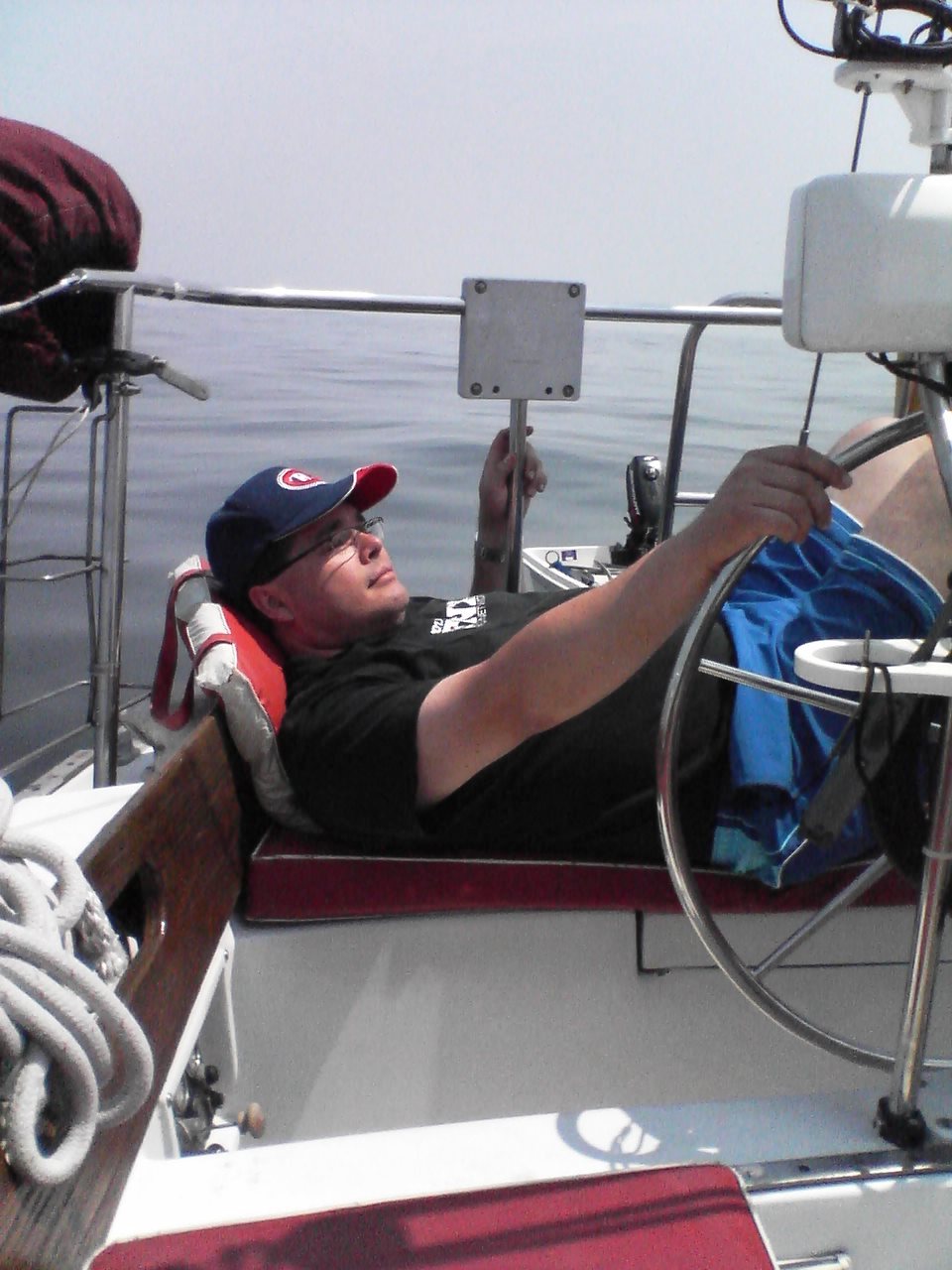
This is the way it should be.
Tuesday, July 04, 2006
Cycling on the Charles River on the 4th of July
Today I drove into Watertown Ma with my mountain bike attached firmly attached to the rear of my Jeep. Although this is the “4th”, in the morning there were parking places along the river for me, my Jeep and bike. I started west under blue skies and shortly crossed the river heading south toward downtown Boston. The run was complicated as people were appearing in larger and larger groups, some walking, some on in-line skates, some jogging and others on bicycles. I was continually zigging and zaging. My trip continued into downtown Boston with a few detours as paths were closed but certain streets were opened to pedestrian and bike traffic. Crossing over the Charles to start my return trip almost drove me to the North End but I eventually made it over the river. heading back to the car in its shady spot near the shore in Watertown. The temperature was rising but was moderated by a cool breeze. Along the river near MIT a very strange craft came into view. It was a car that had been converted into a foot driver paddle-wheeler. Who says innovation is dead? All in all, the trip was 17 miles and my cardiovascular system endured yet another insult.


Monday, July 03, 2006
Single handing on Casco Bay

A blue sky with white fluffy clouds greeted me as I arrived again in South Freeport. Time was spent replacing some of the runners on the main sail so that it would be firmly attached to the mast. Things are running well. The Windchaser and I motored out past Pound-of-tea island into Casco Bay headed toward the Goslings. Being a holiday there was a lot of company. As the wind was brisk only part of the genoa was used but we still laid over on our side. My new camera phone took the picture below and a couple of video clips better depicting the crashing of the waves on the hull. The prospect of rain tomorrow sent me home feeling great about an exciting sail.
Saturday, July 01, 2006
Windsurfing on Lake Quannapowitt
It was a beautiful day with white fluffy clouds on an azure background. Although over the winter, a mouse had eaten two small holes in my sail, I decided to give it a try on lake Quannapowitt in Wakefield MA. It has been almost two years since my last sail but after a few seconds of uneasy equilibrium, it all came back with the foam bubbling up from the stern of the board as we speed over the waves. Two other windsurfers were also honing their skills but with smaller boards that need a higher wind velocity than my larger and older board. Today there was enough wind for both types. The first run went without difficulty but there were a few unscheduled dismounts later in the day. Now the wait to see how my muscles react.
Friday, June 30, 2006

Sunday, June 25, 2006
First sale on eBay

It worked. As noted a few days ago, my windsurfer Independence was put up for sale on eBay. It was listed for “pick up” only as being 12 ft. long it would have been difficult to ship. Two people bid and one met my price. Within a couple of hours after he won the auction, Jesse appeared in our driveway with his dad to pick up the board. He brought cash. After some instruction as to how to assemble mast and sail we tied it to the top of his car and off they drove into the sunset. I had many good times on that board but as I have another, it wasn’t getting used much and was just collecting dust in the garage. I hope that Jesse will have many enjoyable sails on the Independence at his place on a lake in NH.
Friday, June 23, 2006
Sailing with Tiny on Casco Bay Maine
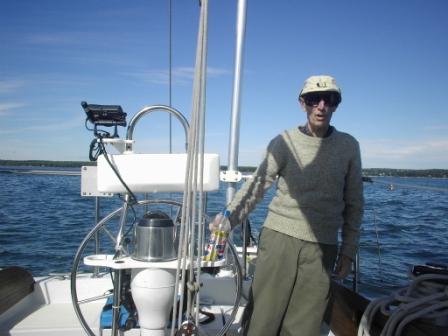
My 89 year old friend Tiny and I took the Windchaser out for a spin on Casco Bay. In the morning the sky was blue with high clouds signaling the change in the weather to rain. Regardless this intrepid duo raised the main and motored out of the harbor into 20 knot winds from the South. A course by Bustin’s Island allowed a reasonable tack that put the boat over on its side. We passed the Goslings and focused on a return plan as low clouds were building and rain looked more and more probable. We almost made it. As we motored past “Pound of Tea” island a gentle but cool rain started to fall. It didn’t build too far and after a time at the mooring tidying things up we took the dingy “plan B” to shore no worse for the wear. This year I have a dingy rack so “plan B” rests out of the water most of the time avoiding the extensive bottom growth experienced in the past. It is amazing how much stuff can grow on blow molded polyethylene.
Tuesday, June 20, 2006
Were the Neanderthal our ancestors?
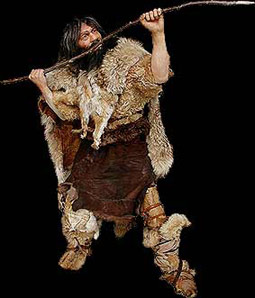
These ancient hominids with brains as large or larger than ours went extinct about 35,000 years ago. Some think that they bred with European Cro-Magnon humans and thus made a contribution to the human race. Recent analysis of ancient DNA from says no. The first Neanderthal DNA to be sequenced was mitochondrial DNA which exists in 100-1000 copies per cell and is only inherited from the mother with no contribution from the father. Because of the high copy number and short length it is the most likely to survive for thousands of years. The mitochondrial DNA sequences suggested that there is no close relationship and that our common ancestor was in the distant past. As there is only one Y chromosome per male cell it is much more difficult to recover from ancient sources. Svante Paabo from the Max Planck institute in Germany used a new technique that is much more tolerant of the degradation found in ancient DNA to sequence 75,000 base pairs from non-mitochondrial nuclear Neanderthal DNA. The specimen was a 45,000 old male from Croatia. Some of the sequences were from the individual’s Y chromosome. The data suggested that Neanderthals and humans had a common ancestor over 315,000 years ago, long before modern humans walked the earth.
A note. The Journal Nature wanted $30 for a one page synopsis of this presentation. I was able to get it for free at the U. Mass. Medical School library but of course had to physically be in the library. This system is outrageous as all paper journals are out of date and don’t have the capabilities of the electronic versions. Tax payers in the U.S. and in this case, Germany, pay for the research, travel and publication costs and then any one who wants to use the information has to pay again. Hopefully, paper journals will die a quick and permanent death and we will not have to pay twice for the electronic versions.
Monday, June 19, 2006
Windsurfer for sale


I am selling my spare windsurfer on EBay Item number: 7249486696
http://cgi.ebay.com/ws/eBayISAPI.dll?ViewItem&item=7249486696&rd=1&sspagename=STRK%3AMESE%3AIT&rd=1 .
At one time my wife was interested but that hasn’t really happened so I don’t need two boards. It’s a great buy. Have fun bidding.
Thursday, June 15, 2006
Seminar on Alzheimer’s disease including innovative microscopy and immunotherapy
Today I attended a seminar at Harvard Medical School by Dr. Hyman ( http://adams.mgh.harvard.edu/cagn/Faculty/hyman.html ) on developments in the understanding of Alzheimers. Two aspects of this presentation were most interesting.
First, Elan pharmaceuticals is in trials of Beta amyloid immunotherapy ( http://www.elan.com/research_development/Alzheimers/ ) as a way to remove the Alzheimrs related beta amylod from the brain and second, the use of a technique called multiphoton confocal microscopy that allows high magnification viewing of live brain tissue.
From Elan’s web site: Beta amyloid immunotherapy is the treatment of Alzheimer’s disease by inducing or enhancing the body’s own immune response in order to clear beta amyloid from the brain. Active immunization stimulates the body’s own immune system to manufacture anti beta amyloid antibodies that may attach to amyloid and clear it from the brain. This, in turn, appears to reduce the build up of beta amyloid in the brain tissue of patients. Through a monoclonal antibody approach (passive immunization), synthetically engineered antibodies directed at beta amyloid are injected into the bloodstream and are thought to help reverse beta amyloid accumulation.
multiphoton confocal microscopy ( http://www.loci.wisc.edu/multiphoton/mp.html ) can look a light only coming from a slice of tissue. Fluorescent tags are used to make specific tissue glow specific colors. The pictures are similar to those form tissue sections but of living tissue. By placing a window in the head of mice the same cells in the same mouse can be observed from day to day. Thus, changes can be monitored in a single animal providing information that is almost impossible to obtain if the animal has to be sacrificed in order to observe the brain tissue microscopically. This is great stuff.
Multiphoton Studies in Alzheimers disease models
Speaker's Name: Bradley Hyman, M.D., Ph.D.
Speaker's Affiliation: Massachusetts General Hospital
Location_Line 1: Room 122, Goldenson Building
Location_Line 2: CBR Institute for Biomedical Research, Inc.
Location_Line 3: 220 Longwood Ave, Boston
Contact Name/Phone#: Kyle Shovlin, 617-278-3226
Details:
Dr. Brad Hyman,John B Penney Professor,Massachusetts General Hospital,
Harvard Medical School will be delivering a CBRI Seminar on June 15,
2006 at 220 Longwood Ave. -Goldenson Rm 122
First, Elan pharmaceuticals is in trials of Beta amyloid immunotherapy ( http://www.elan.com/research_development/Alzheimers/ ) as a way to remove the Alzheimrs related beta amylod from the brain and second, the use of a technique called multiphoton confocal microscopy that allows high magnification viewing of live brain tissue.
From Elan’s web site: Beta amyloid immunotherapy is the treatment of Alzheimer’s disease by inducing or enhancing the body’s own immune response in order to clear beta amyloid from the brain. Active immunization stimulates the body’s own immune system to manufacture anti beta amyloid antibodies that may attach to amyloid and clear it from the brain. This, in turn, appears to reduce the build up of beta amyloid in the brain tissue of patients. Through a monoclonal antibody approach (passive immunization), synthetically engineered antibodies directed at beta amyloid are injected into the bloodstream and are thought to help reverse beta amyloid accumulation.
multiphoton confocal microscopy ( http://www.loci.wisc.edu/multiphoton/mp.html ) can look a light only coming from a slice of tissue. Fluorescent tags are used to make specific tissue glow specific colors. The pictures are similar to those form tissue sections but of living tissue. By placing a window in the head of mice the same cells in the same mouse can be observed from day to day. Thus, changes can be monitored in a single animal providing information that is almost impossible to obtain if the animal has to be sacrificed in order to observe the brain tissue microscopically. This is great stuff.
Multiphoton Studies in Alzheimers disease models
Speaker's Name: Bradley Hyman, M.D., Ph.D.
Speaker's Affiliation: Massachusetts General Hospital
Location_Line 1: Room 122, Goldenson Building
Location_Line 2: CBR Institute for Biomedical Research, Inc.
Location_Line 3: 220 Longwood Ave, Boston
Contact Name/Phone#: Kyle Shovlin, 617-278-3226
Details:
Dr. Brad Hyman,John B Penney Professor,Massachusetts General Hospital,
Harvard Medical School will be delivering a CBRI Seminar on June 15,
2006 at 220 Longwood Ave. -Goldenson Rm 122
Saturday, June 10, 2006
From Ft. Lauderdale to Rhode Island on a trawler passagemaker

My world has just about stopped swaying back and forth after our wonderful trip from Fort Lauderdale to Rhode Island. It was an exciting experience and will be related in this blog as I get the time. Many thanks to the two gracious owners and our expert captain.
While most of the journey was delightful, we did run aground, loose the wing engine, overheat the generator, require the repair of an open through - hull that could have sunk the boat, become a target for the Navy, suffer attack by thousands of flies off the coast of Delaware, doge container ships in the fog and learn of the murder of an acquaintance.
The picture is of a Selene 47 passagemaker, similar to the one used on this adventure, that steams along at only 8 nautical miles per hour but can cross oceans in substantial comfort.
Chronicle of the great ship Auriga and its perilous journey to the far North
On a windy, rainy day I hurtled down an empty interstate toward Chris's new rented dock in Warren RI. The purpose was to park the Jeep to provide transport on our return. During the process we met Mr. Cherry, a full time live “a-boarder”, had a couple of beers at a local watering hole and drove to Chris's home on the shore. Chris, Irina and I walked along the shore in the moonlight to a special pizza parlor where we enjoyed a jalapeno et. al. pizza washed down with Guinness. Back home we watched “House” on their new HD flat screen television and went to bed.
PassageMaker Auriga Chronicle 5/17/06

We shook out the sand at 4:00 am & drove to the airport for a 7:10 am flight under a bright sun and clear blue sky. The flight went well and we easily made the connecting flight in Philadelphia after a long walk from concourse to concourse. Chris’s ear infection seemed to be of little trouble so it was good that he did not take the day and a half long train ride to Ft. Lauderdale. All bags appeared in baggage claim and we speed off into the suburbs of Fort Lauderdale in our new rental car. The boat was at a dock in a residential area. Each small house backed up to a palm lined canal with many such boats both sail and power in tight parallel rows. Dinner was at a Mexican restaurant with tamales and blue agave tequilas. The smoky taste of blue agave tequila imparts a special pleasure to margarita drinking. The night was warm early on but cooled as the dawn approached. However, the boat across the canal periodically discharged water from its cooling system which, through the open porthole, sounded like the Jolly Green Giant urinating. .
Subscribe to:
Posts (Atom)
