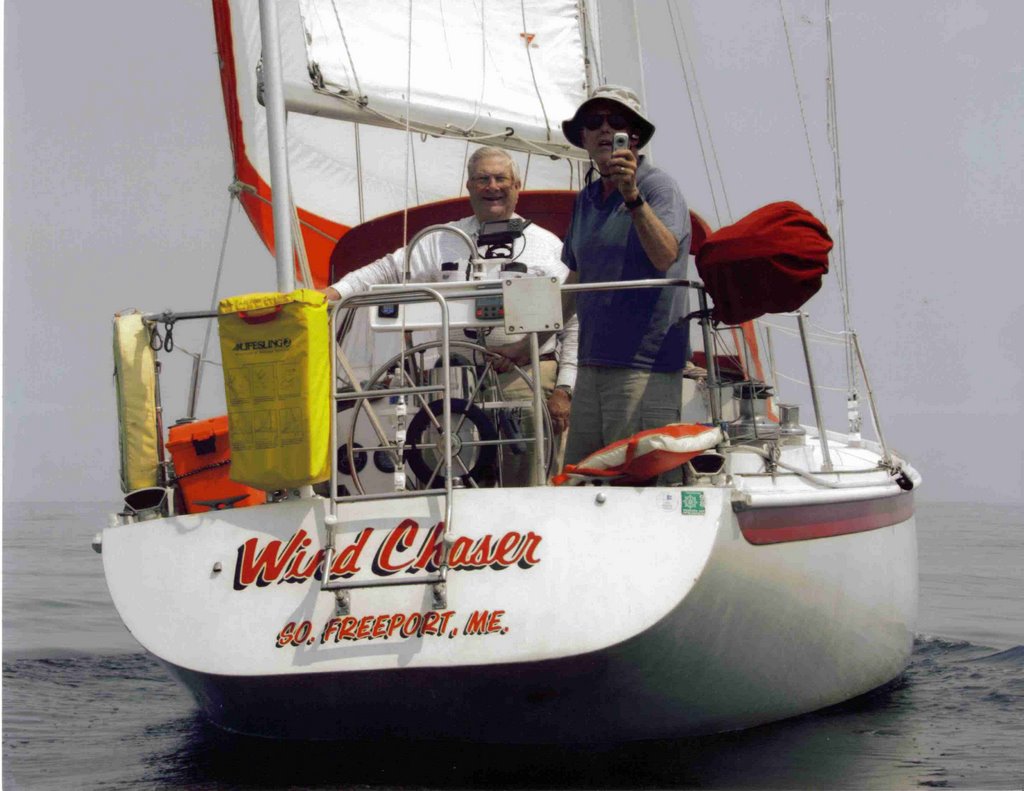
Wendy was honored to receive the Masters Award stock pin at the annual meeting yesterday. The award was presented by joint master Hum.
Sunday, May 27, 2007
Sunday, May 20, 2007
Motor Sailer Cruise Greek Cycladies May 4 - 11 2007
I and 18 others took the Motor sailor HB II (all wood made in Turkey) on a tour of the Greek Cycladies islands as shown on the map below. The boat usually holds 40 so we had plenty of room. After the cruise I rented a car and drove to various sites in Greece before my return on the 15th. The blogs below are a partial chronicle of the trip. Comments are welcome.
Monday, May 14, 2007
Greece Arkitsa Thermopylae Galaxidi Loutsa
After Delphi and a night in the small port of Galaxidi I headed over the mountains to Thermopylae. It was another beautiful drive with it's share of switchbacks but nothing like the days before. I stopped at the small exhibit at Thermopylae where a small band of Greeks failed to halt a large army of Persians due to a traitor. I then headed back toward Athens on the Autobahn A1. They are improving the roads in Greece but have as yet not gotten to putting route signs along the road. I stopped at the small port of Arkitsa as the highway headed off through the mountains and that was the last water before Athens. After much searching and many small streets a very nice hotel was located. The room was 25 Euros with a balcony looking over the water. It later turned out that I was the only guest at this 40 room hotel. I was also the only guest at the previous hotel. It must be that this is pre-season.
After going to the room I put on my swim trunks and headed for the water which was cool but nothing like Maine. Looking back at the shore everything was green with many flowers and palm trees. Back in the room I looked at myself and saw many small red spots that itched. Then it cam back to me. The previous hotel had many mosquitoes and something similar to no-seeums. I had been attacked in the night and must have provided many a good meal for the little devils. After two weeks my clothes needed a wash. I asked the manager if they could do a wash for me. He said no but he would let me use their stuff to do a was. Their stuff turned out to be a plastic tub with some soap powder. Placed in the shower it worked well and the balcony provided an excellent drying location.
Sitting on the veranda I talked to the hotel manager. He turned out to have spent three years at BU and was back in Greece working for the Government and helping his parents with the hotel and olive groves. His sister -in-law came by pushing her 6 month old boy in a perambulator. Mother, father and other brother came by and we had a great conversation. You get a lot of attention when you are the only customer.
In the morning I headed for Athens to get a hotel as I must be at the airport at 5:00 am to turn in my car and catch the plane. There are no inexpensive hotels anywhere near the airport. The Sofetel at the airport starts at $400 and a Holiday Inn 7 miles towards Athens has rooms at $180 but those were gone and the only others were $250. I drove all over the place through industrial areas and small towns but not hotels. The only solution was to go to the beach. The shore village of Loutsa had a very nice hotel on the beach for 60 Euros so I had a great lunch looking at the sea, another cool swim and here I am at an internet cafe writing to you.
If I can get up a little after 4:00 am and the rental car guy shows up I should see you soon.
The good news about Greece is that it is beautiful, clean and has all the amenities. The bad news is that it is no longer inexpensive.


After going to the room I put on my swim trunks and headed for the water which was cool but nothing like Maine. Looking back at the shore everything was green with many flowers and palm trees. Back in the room I looked at myself and saw many small red spots that itched. Then it cam back to me. The previous hotel had many mosquitoes and something similar to no-seeums. I had been attacked in the night and must have provided many a good meal for the little devils. After two weeks my clothes needed a wash. I asked the manager if they could do a wash for me. He said no but he would let me use their stuff to do a was. Their stuff turned out to be a plastic tub with some soap powder. Placed in the shower it worked well and the balcony provided an excellent drying location.
Sitting on the veranda I talked to the hotel manager. He turned out to have spent three years at BU and was back in Greece working for the Government and helping his parents with the hotel and olive groves. His sister -in-law came by pushing her 6 month old boy in a perambulator. Mother, father and other brother came by and we had a great conversation. You get a lot of attention when you are the only customer.
In the morning I headed for Athens to get a hotel as I must be at the airport at 5:00 am to turn in my car and catch the plane. There are no inexpensive hotels anywhere near the airport. The Sofetel at the airport starts at $400 and a Holiday Inn 7 miles towards Athens has rooms at $180 but those were gone and the only others were $250. I drove all over the place through industrial areas and small towns but not hotels. The only solution was to go to the beach. The shore village of Loutsa had a very nice hotel on the beach for 60 Euros so I had a great lunch looking at the sea, another cool swim and here I am at an internet cafe writing to you.
If I can get up a little after 4:00 am and the rental car guy shows up I should see you soon.
The good news about Greece is that it is beautiful, clean and has all the amenities. The bad news is that it is no longer inexpensive.
Friday, May 11, 2007
Greece Pellopenese Athens Mycenae Olympia
Last night we ended up in a hotel near one of the many harbors. It had a roof-top restaurant and pool. Diving into that pool was a real delight late in the afternoon. In the evening I and a view from our boat went to another restaurant that was also rooftop and gave a truly beautiful view of the harbor with the surround hills aglow from the many homes. In the morning my car arrived as planed. A picture of the car guy and car is attached. To drop it off at the airport Tue morning he will meet me at 5:00 am at the departure area. Thus the picture so I can remember what he looks like. I hope this works.
After a challenging ride through downtown Athens I went to the autobahn and proceeded to the Pellopenese. My first stop was Mycenae and evidenced by the picture of me under the lions gate. Standing under this gate has been one of my goals for many years. After a viewing of Artimis's tomb which is a very large beehive shaped structure I started off for Olympia. What looked like a major route turned out to be a mountain road with incredible views of the mountains and lush green valleys. There was a lot of white knuckle driving over many switchbacks with nothing in the way of guard rails. A little over 100 km took me all afternoon but landed me in Olympia for the night. It is big enough for an internet cafe. The view from my rented computer is attached.


After a challenging ride through downtown Athens I went to the autobahn and proceeded to the Pellopenese. My first stop was Mycenae and evidenced by the picture of me under the lions gate. Standing under this gate has been one of my goals for many years. After a viewing of Artimis's tomb which is a very large beehive shaped structure I started off for Olympia. What looked like a major route turned out to be a mountain road with incredible views of the mountains and lush green valleys. There was a lot of white knuckle driving over many switchbacks with nothing in the way of guard rails. A little over 100 km took me all afternoon but landed me in Olympia for the night. It is big enough for an internet cafe. The view from my rented computer is attached.
Thursday, May 10, 2007
Greece Poseidon Kythnos Delos Mykonos
I am actually back in Athens after a line broke on the cooling system of one of the diesel engines on the HB II. We limped into the closest port which was near the tip of Attica. We disembarked and took a bus to the temple of Poseidon on a high promontory overlooking an azure sea. It is difficult to describe how beautiful the land and sea are. Then we motored to a restaurant at a beach and had and excellent fish lunch. The only problem is that it was the whole fish and I hate to have it look back at me when I am eating it. I assume it had minimal mental function after being fried. I wasn't able to Email yesterday as the small port of Kythnos didn't have a functioning internet cafe. I went for a swim and we had the captain's dinner for which I wore the sport I have been carrying around the whole trip. The evening was great except for the Adiddas sales people who partied until 3:30 am next door. The previous day we were at the island of Delos which has very large ruins there were impressive. The only people who live on the island are the caretakers. We then went to nearby Mykonos which has an airport and is filled with resorts and homes for the rich and famous.


Tuesday, May 08, 2007
Greece islands Paros Delos
We docked at the Island of Paros and rented ATV's for a run around the lisland. It was a lot of fun and similar to driving a snowmobile as one needed speed to get up some of the hills. The thing was stable but not too powerful. On our adventure we explored an ancient cave that was a marble mine, had refreshments at a restaurant in an old village overlooking the sea and visited a horse farm that seemed to have about 10 head and a round pen. In the evening we went to a greek restaurant, what else, for great food, music and dancing.
Tomorrow we go the the island of Delos to view some very extensive ruins.


Tomorrow we go the the island of Delos to view some very extensive ruins.
Monday, May 07, 2007
Greece Santorini, Sinfos and Paros islands
We have just docked in Paros after a day and a night in Sifnos. Santorini is still my favorite and worth the trip by itself. Everything has been wonderful with great weather, a great room, nice fellow passengers (18) and views better than I expected. I got to try out some of the local transportation and was able to take the wheel as I let the captain use my GPS. There was none on the boat and they seem to steer by lights on the island they are passing. I don't know what they would do in a fog. Also, moored near me was a Russian family with a Russian captain who were cruising the Med. Valintine is ex-KGB but he said that he never saw my file and that we should bury the hatchet. The conversation was a lot of fun. He now runs a marina somewhere in Russia and plans to take his family to sea for a couple of years.


Friday, May 04, 2007
Touring Athens and Piraeus Greece
I am spending two weeks in Greece part on a motor sailer and part just driving around.
Today I levave for the sailing craft and the Islands. Yesterday I did the Acropolis and several marinas near the port of Piraeus. During my adventures there was an attack by birds at a cafe, an encounter with pirates and a near miss on the street as a local motorist hit a fellow on a motorcycle that came flying towards me on the sidewalk but missed. Crossing the streets here is dangerous but I always thougth that I would be safe on the sidewalk. No more! Fortunately the cyclist was able to right his cycle and walk off the road upset but unhurt.


Today I levave for the sailing craft and the Islands. Yesterday I did the Acropolis and several marinas near the port of Piraeus. During my adventures there was an attack by birds at a cafe, an encounter with pirates and a near miss on the street as a local motorist hit a fellow on a motorcycle that came flying towards me on the sidewalk but missed. Crossing the streets here is dangerous but I always thougth that I would be safe on the sidewalk. No more! Fortunately the cyclist was able to right his cycle and walk off the road upset but unhurt.
Saturday, April 07, 2007
Mini horse farm in North Carolina
We purchased a house and land at foreclosure and have been re-habing it for a couple of months. The land needed to be cleared, fence added, roof redone coupled with electrical and plumbing. Soon we will head up North and do more on the place next Spring.

Same view now - back
As purchased - back

Same view now - back
Current Front
Monday, February 26, 2007
Sunday, February 11, 2007
Friday, February 02, 2007
Life is great in Aspen Snowmass


We are about to leave after 5 days of brite sun and excellent skiing followed by two days of powder. Several great lunches were enjoyed on the mountain at Gwen's High Alpine. Gourmet dining high on the mountain. We also enjoyed Twrp Anderson and John Sommers at the Silvertree apre ski. There were several medical meetings and we had some great converstations about medical genetics
Monday, January 15, 2007
Will new gene discoveries substantiate bigotry? The ASPM gene
The explosion in DNA analysis can expose differences between us that affect our abilities and can be screened for before birth. There may be correlations with race but there are now questions as to whether the human races have statistical reality. This means that there can be more variation within the classical races than between them. It is now relatively well accepted that humans originated in Africa between 100 and 200 thousand years ago and that all non-Africans left the continent less than 70,000 years ago as a very small group. We are a very young species that has almost gone extinct more than once. We populated the world very rapidly displacing earlier hominids such as homo erectus and Neanderthal. There was something different about us that gave us a significant advantage. We are on the verge of identifying just which genes made us human and which variants of these genes are “best”. Such identifications will allow “inferior” individuals to be identified in the womb and eliminated. It also may result in us being categorized at birth as to our future potential and segregated into different groups based on these determinations.
Many “intelligence” genes are identified by examining the DNA of individuals with mental handicaps. One such example is the ASPM gene which was identified as the causative agent in inherited microcephaly.
http://eprints.iisc.ernet.in/archive/00000196/03/629.pdf
It is claimed as described below, that this gene has undergone recent rapid evolution suggesting that it is very important to human development. Also, not all humans have the same variants of the gene. Does this affect IQ? No, as described in the article from Science magazine. http://www.sciencemag.org/cgi/content/full/314/5807/1872 and the variations in this gene in the “normal” population don’t seem to correlate with brain size. Some mutations of the ASPM gene do cause a significant decrease in brain size resulting in microcephaly but other genetic variation seen in people with normal brain size don’t seem to mater. There are many mutations that while different in genetic sequence make no change in phenotype of gene function.
However, there must be genetic control of intelligence, the genes will be discovered and we will probably discriminate. Its only human.
Excerpts from http://www.futurepundit.com/archives/001892.html
Bruce Lahn and collaborators have discovered signs of strong selective pressure in primates on a gene that affects brain size.
The researchers, led by Howard Hughes Medical Institute (HHMI) investigator Bruce Lahn at the University of Chicago, reported their findings in an advance access article published on January 13, 2004, in the journal Human Molecular Genetics. Patrick Evans and Jeffrey Anderson in Lahn's laboratory were joint lead authors of the article.
Lahn and his colleagues found that the ASPM gene showed clear evidence of changes accelerated by evolutionary pressure in the lineage leading to humans, and the acceleration is most prominent in recent human evolution after humans parted way from chimpanzees.
“In our work, we have looked at evolution of a large number of genes, and in the vast number of cases, we see only weak signatures of adaptive changes,” said Lahn. “So, I was quite surprised to see that this one gene shows such strong and unambiguous signatures of adaptive evolution — more so than most other genes we've studied.”
By contrast, the researchers' analyses of the ASPM gene in the more primitive monkeys and in cows, sheep, cats, dogs, mice and rats, showed no accelerated evolutionary change. “The fact that we see this accelerated evolution of ASPM specifically in the primate lineage leading to humans, and not in these other mammals, makes a good case that the human lineage is special,” said Lahn.
You might be wondering how exactly scientists can detect selective pressure on a gene. Note how the article talks about mutations that are not functionally significant versus mutations that are functionally significant. Well, compare two related species for the ratio of functionally significant to functionally insignificant variations in the same gene. The higher the ratio the higher the selective pressure must have been.
Here's an intuitive example of why ratios of functionally signficant to functionally insignificant mutations reveal the extent of past selective pressure: Suppose at some point in the past there was a species that has only a million animals of that species. Suppose they had some gene we will call X. Suppose they all had only functionally insignificant mutations in X and that between the million animals of that species they had 20 different combinations of mutations in X. Then suppose a single animal in that species was born that had a mutation in X that caused a functional change that made that animal more adaptive. Perhaps the mutation in X made the animal smarter and therefore more successful in finding food. Well, that animal with the "smart X" variation also had one of the existing 20 combinations of functionally insignificant mutations. The other 19 combinations existed only in animals that did not have the "smart X" intelligence-enhancing mutation. All the other animals of that species will therefore be less successful, on average, at reproducing. That will, over a period of generations, cause those other 19 combinations in the X gene to become far less common. Many of the combinations in X likely will disappear entirely as their carriers become outcompeted in the search for food and fail to reproduce successfully. The 1 combination of insignificant variations that occurs with the "smart X" mutation will become far more common and may become the only combination of insignificant variations in the X gene until new insignificant combinations start accumulating across generations as new mutations happen in animals that have the "smart X" mutation.
The point is that a valuable mutation will mprove the relative reproductive success of the first animal that gets it. But then any unimportant or less important mutations that animal also has will be propagated along with the important mutation. The amount of overall variation in that gene will go down in future generations as the animals that do not have the valuable mutation but which have various functionally insignificant mutations do not reproduce as successfully. Valuable mutations have the effect of reducing the number of functionally unimportant mutational variations that will be found around genes that has the valuable mutations.
Update: Nicholas Wade of the New York Times has more details about the historical frequency of ASPM mutations.
"There has been a sweep every 300,000 to 400,000 years, with the last sweep occurring between 200,000 and 500,000 years ago," Dr. Lahn said, referring to a genetic change so advantageous that it sweeps through a population, endowing everyone with the same improved version of a gene.
By this measure humans may be due for another ASPM mutation. Perhaps there is some human out there walking around with the next intelligence-enhancing ASPM mutation.
Where Lahn talks about a mutation that "sweeps through a population" understand what that really means: All animals that did not have the mutation in a given species were outcompeted and, over some generations, failed to reproduce. The mutation didn't just jump from one ape to another ape like a viral infection. The line of successive mutations were each so helpful for enhancing survival and reproduction that animals that didn't have them were outcompeted for food or for mates or in fights and perhaps in all of those ways.
Wade says at least 5 other genes cause microcephaly but they have not yet been identified. Once they are expect evolutionary geneticists to repeat the same comparison between species as was done with ASPM. While few humans appear to have functional variations in ASPM (aside from victims of microcephaly) it is possible that some of these yet-to-be-discovered genes will turn out to vary between humans. Humans do vary in brain size and brain shape. Genetic variations in some genes must be causing this. Though some of those variations might be occurring in genes that are not responsible for microcephaly.
By Randall Parker at 2004 January 14 12:29 AM Trends, Human Evolution TrackBack
Many “intelligence” genes are identified by examining the DNA of individuals with mental handicaps. One such example is the ASPM gene which was identified as the causative agent in inherited microcephaly.
http://eprints.iisc.ernet.in/archive/00000196/03/629.pdf
It is claimed as described below, that this gene has undergone recent rapid evolution suggesting that it is very important to human development. Also, not all humans have the same variants of the gene. Does this affect IQ? No, as described in the article from Science magazine. http://www.sciencemag.org/cgi/content/full/314/5807/1872 and the variations in this gene in the “normal” population don’t seem to correlate with brain size. Some mutations of the ASPM gene do cause a significant decrease in brain size resulting in microcephaly but other genetic variation seen in people with normal brain size don’t seem to mater. There are many mutations that while different in genetic sequence make no change in phenotype of gene function.
However, there must be genetic control of intelligence, the genes will be discovered and we will probably discriminate. Its only human.
Excerpts from http://www.futurepundit.com/archives/001892.html
Bruce Lahn and collaborators have discovered signs of strong selective pressure in primates on a gene that affects brain size.
The researchers, led by Howard Hughes Medical Institute (HHMI) investigator Bruce Lahn at the University of Chicago, reported their findings in an advance access article published on January 13, 2004, in the journal Human Molecular Genetics. Patrick Evans and Jeffrey Anderson in Lahn's laboratory were joint lead authors of the article.
Lahn and his colleagues found that the ASPM gene showed clear evidence of changes accelerated by evolutionary pressure in the lineage leading to humans, and the acceleration is most prominent in recent human evolution after humans parted way from chimpanzees.
“In our work, we have looked at evolution of a large number of genes, and in the vast number of cases, we see only weak signatures of adaptive changes,” said Lahn. “So, I was quite surprised to see that this one gene shows such strong and unambiguous signatures of adaptive evolution — more so than most other genes we've studied.”
By contrast, the researchers' analyses of the ASPM gene in the more primitive monkeys and in cows, sheep, cats, dogs, mice and rats, showed no accelerated evolutionary change. “The fact that we see this accelerated evolution of ASPM specifically in the primate lineage leading to humans, and not in these other mammals, makes a good case that the human lineage is special,” said Lahn.
You might be wondering how exactly scientists can detect selective pressure on a gene. Note how the article talks about mutations that are not functionally significant versus mutations that are functionally significant. Well, compare two related species for the ratio of functionally significant to functionally insignificant variations in the same gene. The higher the ratio the higher the selective pressure must have been.
Here's an intuitive example of why ratios of functionally signficant to functionally insignificant mutations reveal the extent of past selective pressure: Suppose at some point in the past there was a species that has only a million animals of that species. Suppose they had some gene we will call X. Suppose they all had only functionally insignificant mutations in X and that between the million animals of that species they had 20 different combinations of mutations in X. Then suppose a single animal in that species was born that had a mutation in X that caused a functional change that made that animal more adaptive. Perhaps the mutation in X made the animal smarter and therefore more successful in finding food. Well, that animal with the "smart X" variation also had one of the existing 20 combinations of functionally insignificant mutations. The other 19 combinations existed only in animals that did not have the "smart X" intelligence-enhancing mutation. All the other animals of that species will therefore be less successful, on average, at reproducing. That will, over a period of generations, cause those other 19 combinations in the X gene to become far less common. Many of the combinations in X likely will disappear entirely as their carriers become outcompeted in the search for food and fail to reproduce successfully. The 1 combination of insignificant variations that occurs with the "smart X" mutation will become far more common and may become the only combination of insignificant variations in the X gene until new insignificant combinations start accumulating across generations as new mutations happen in animals that have the "smart X" mutation.
The point is that a valuable mutation will mprove the relative reproductive success of the first animal that gets it. But then any unimportant or less important mutations that animal also has will be propagated along with the important mutation. The amount of overall variation in that gene will go down in future generations as the animals that do not have the valuable mutation but which have various functionally insignificant mutations do not reproduce as successfully. Valuable mutations have the effect of reducing the number of functionally unimportant mutational variations that will be found around genes that has the valuable mutations.
Update: Nicholas Wade of the New York Times has more details about the historical frequency of ASPM mutations.
"There has been a sweep every 300,000 to 400,000 years, with the last sweep occurring between 200,000 and 500,000 years ago," Dr. Lahn said, referring to a genetic change so advantageous that it sweeps through a population, endowing everyone with the same improved version of a gene.
By this measure humans may be due for another ASPM mutation. Perhaps there is some human out there walking around with the next intelligence-enhancing ASPM mutation.
Where Lahn talks about a mutation that "sweeps through a population" understand what that really means: All animals that did not have the mutation in a given species were outcompeted and, over some generations, failed to reproduce. The mutation didn't just jump from one ape to another ape like a viral infection. The line of successive mutations were each so helpful for enhancing survival and reproduction that animals that didn't have them were outcompeted for food or for mates or in fights and perhaps in all of those ways.
Wade says at least 5 other genes cause microcephaly but they have not yet been identified. Once they are expect evolutionary geneticists to repeat the same comparison between species as was done with ASPM. While few humans appear to have functional variations in ASPM (aside from victims of microcephaly) it is possible that some of these yet-to-be-discovered genes will turn out to vary between humans. Humans do vary in brain size and brain shape. Genetic variations in some genes must be causing this. Though some of those variations might be occurring in genes that are not responsible for microcephaly.
By Randall Parker at 2004 January 14 12:29 AM Trends, Human Evolution TrackBack
Friday, December 08, 2006
Wednesday, November 15, 2006
Tuesday, November 07, 2006
What did the Neanderthals give us?
These hominids are older than modern humans with larger brains. However, the tool kits that were discovered with their bones were not as sophisticated as their co-existing modern humans. They did not seem as smart. DNA studies, especially those of mitochondrial DNA show that the relationship is distant suggesting no contribution from the Neanderthals that lived near our direct ancestors. Now, a gene related to brain development, microcephalin that we all have appears to be too old. Current mutations seem to suggest an origin of haplotype D form of the gene in modern humans at 37,000 years ago but the gene itself seems to be over 1 million years old. Where was it before 37,000 years ago? One possible explanation is that we obtained haplotype D by breeding with Neanderthals in whom it had been resident for over a million years. However we got it, the D haplotype spread very rapidly. If the Neanderthals had it first, then why did we win? We must have had something else. One interesting aspect of this hypothesis is that modern humans came out of Africa earlier than 37000 years ago so those left in Africa would not be expected to have haplotype D.
University of Chicago geneticist Bruce Lahn
Wednesday, November 01, 2006
Sunday, October 22, 2006
Foot Race Groton Trails Commettee
Check out the ONBH Blog at www.onbh.blogspot.com
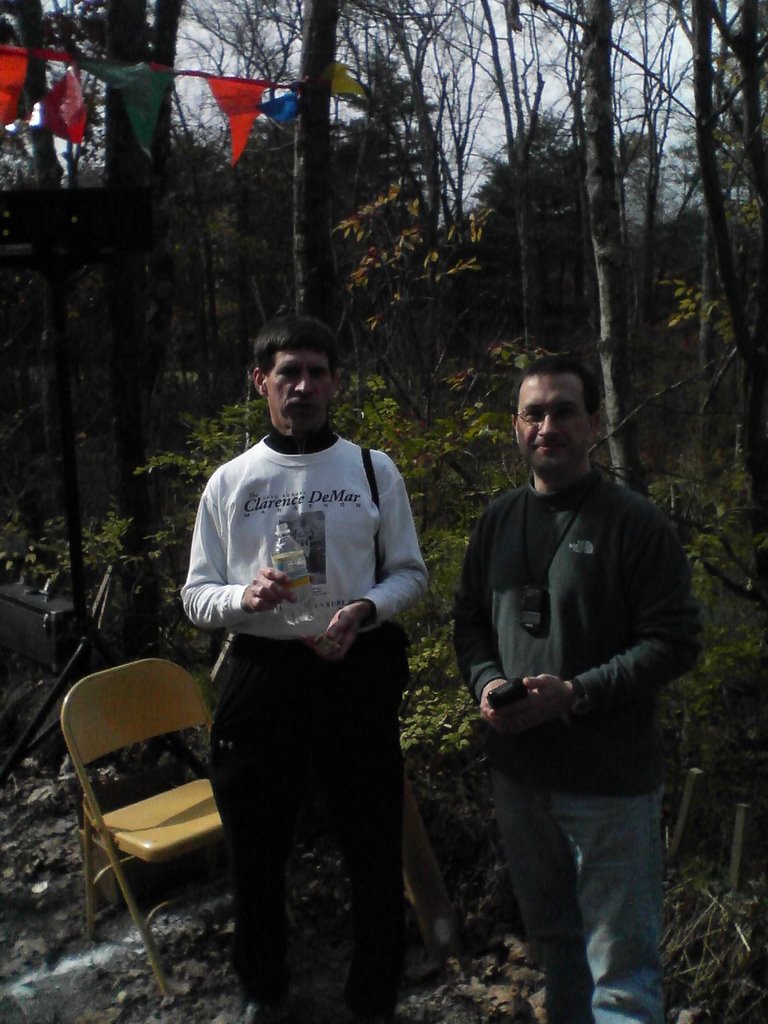
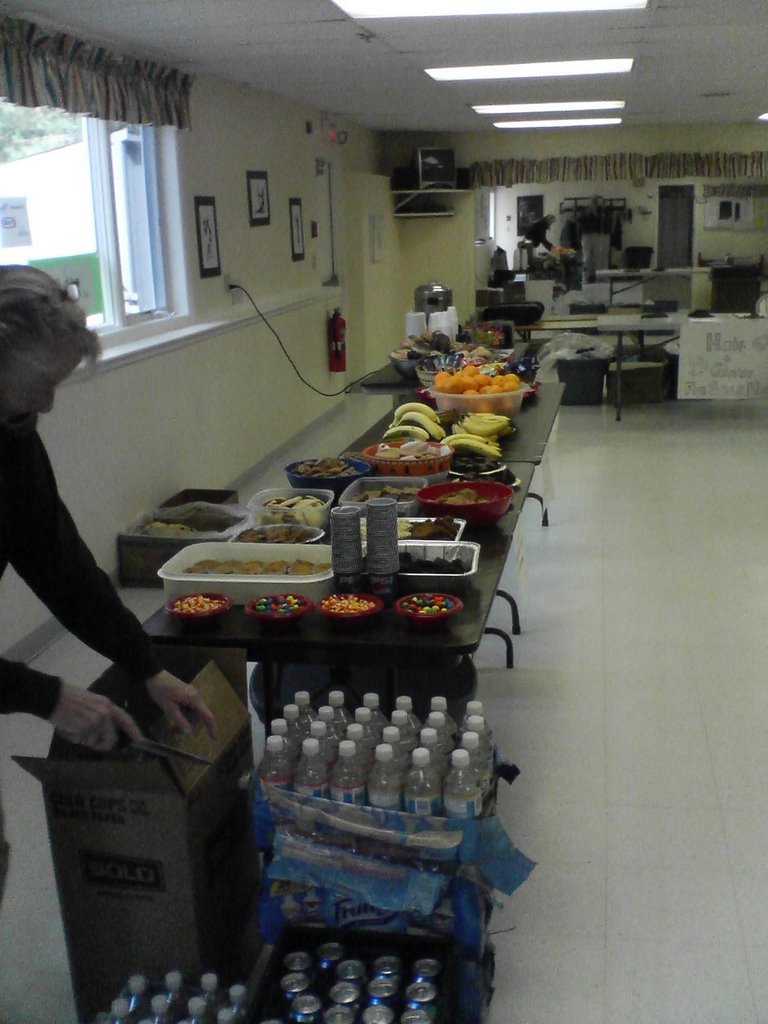
Today there was a foot race through the Groton Town Forrest sponsored in part by the Groton trails committee in which my wife is active. The weather was bright, cool and clear, excellent conditions for such a race. I helped out with food for the runners to eat after the race. It is amazing how many brownies such fit people can eat.


Today there was a foot race through the Groton Town Forrest sponsored in part by the Groton trails committee in which my wife is active. The weather was bright, cool and clear, excellent conditions for such a race. I helped out with food for the runners to eat after the race. It is amazing how many brownies such fit people can eat.


Tuesday, October 17, 2006
Friday, October 13, 2006
Subscribe to:
Posts (Atom)